
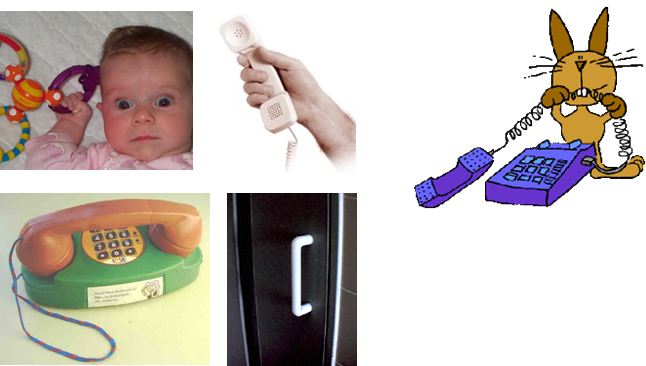
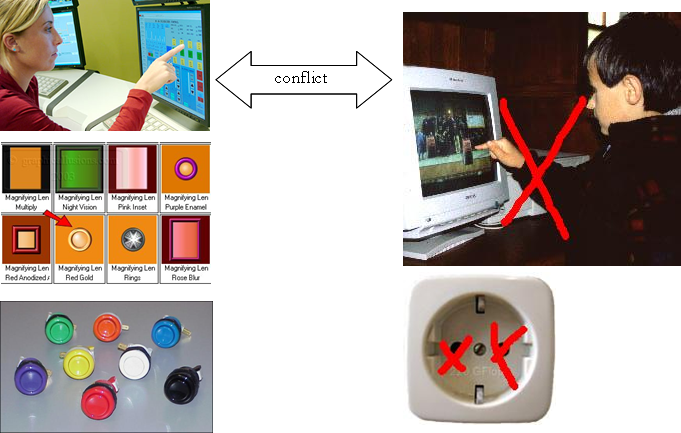
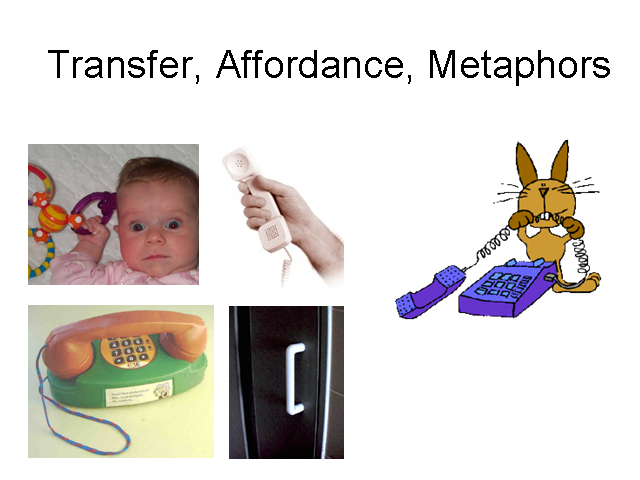
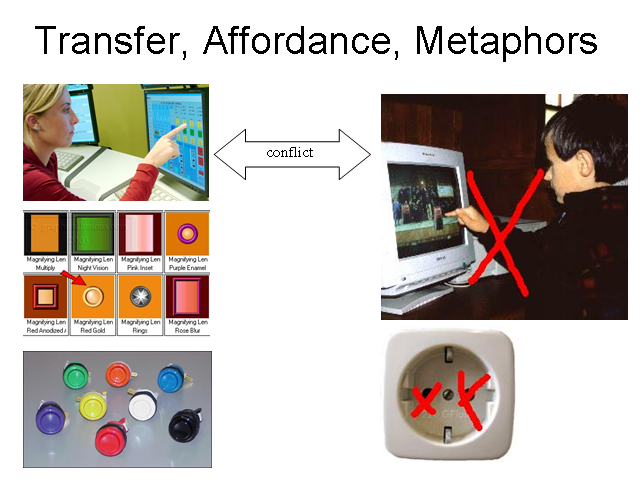
Transfer, Affordance, Metaphors
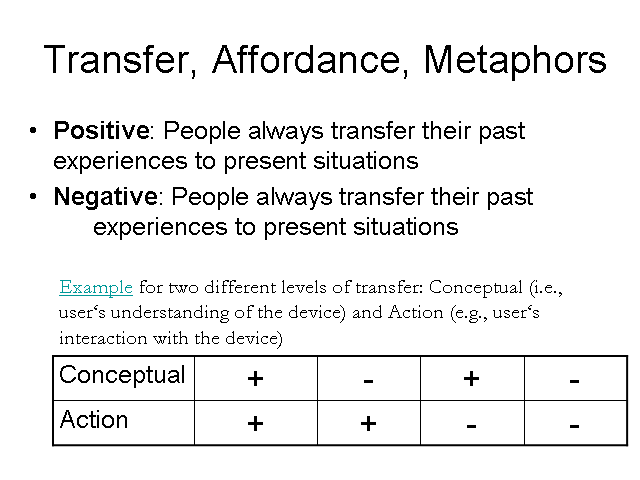
- Positive: People always transfer their past experiences to present situations
- Negative: People always transfer their past experiences to present situations
| Conceptual | + | - | + | - |
| Action | + | + | - | - |

Supporting Users‘ Cognition
- Repetitio mater studiorum est
- Consistency and Interference
- Recognition is easier than recall
- Learning and thinking is context dependent
- Law of Experience -> Transfer of Learning
- Use simple conceptual models oriented at the goals of the user
Supporting Users‘ Cognition
- Repetitio mater studiorum est
- Consistency and Interference
- Recognition is easier than recall
- Learning and thinking is context dependent
- Law of Experience -> Transfer of Learning
- Use simple conceptual models oriented at the goals of the user
- Enable meaningful experiences (e.g., semantics over syntax, self-explaining terminology)
Supporting Users‘ Cognition
- Repetitio mater studiorum est
- Consistency and Interference
- Recognition is easier than recall
- Learning and thinking is context dependent
- Law of Experience -> Transfer of Learning
- Use simple conceptual models oriented at the goals of the user
- Enable meaningful experiences (e.g., semantics over syntax, self-explaining terminology)
- Address different modalities (≠ developping fancy multi-media interfaces)
Motor Control
- Learning, remembering, selecting, planning, and controling of movement during execution
- The production of purposeful, goal-directed movement pervades all human activity and are a necessary part of interacting with our environment (-> HCI)
Some Key Topics in Motor Control
- Speed vs. Accuracy
- Degrees of freedom
- Simultaneous motor movement
- Visuo-motor integration
- Serial order, motor programs, schemata, scripts
- Skill acquisition
- Strong memory (also interference, negative transfer)
The Model Human Processor
- Perception system
- Cognition system
- Motor system
- ----------------------------
- Affective System?
Reasons for Integrating Affect
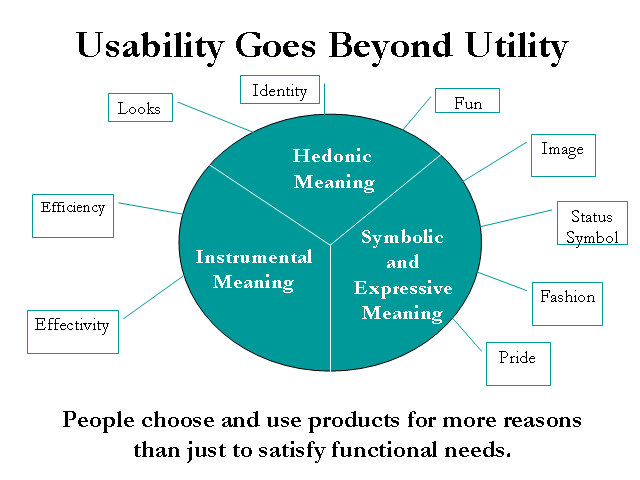
- User experience vs. usability & utility
- „Attractive things work better“ (Norman, 2002)
- Emotions as biggest differentiator in user experience
- Difference between skill and will
- Emotions are part of cognition, affect our perception, attention, thinking, and guide our behavior
- The Final Frontier (e.g., Affective Computing and AI)
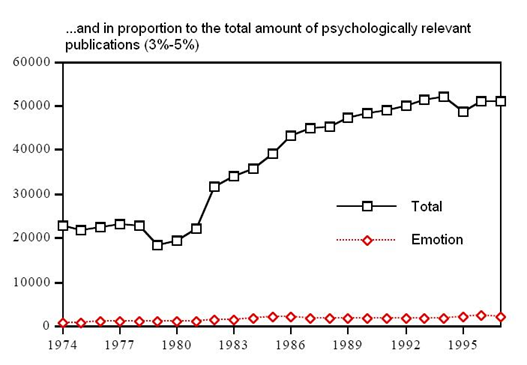
HCI focus over time
- 1960- : UI for expert users (system operators)
- 1970- : From Main Frame to Desktop machine
- 1980- : Increasingly novice users (GUI)
- 1990- : Ubiquitous computing, consistent interfacing
- 2000- : User experience, Socio-emotional dimension of HCI
Why Affect has been discared?
- Dominance of Cognitive Psychology and their adaptation of a deficient Information Processing metaphor to the study of humans
- Irrational emotions distract from the study of pure cognition
- Dispute over emotion theory
- Measurement problem
What Is an Emotion?
- Everybody knows - except scientists
- Emotion as
- Content experience (feeling)
- Physical experience
- Motivational and behavioral indicator
- „Emotions as ratiomorph evaluations“ (Bischof, 1985)
- „Emotions as action tendencies“ (Frijda, 1986)
- Affect family: Emotions, Moods, Motivations, Values, Needs
Why Do We Have Emotions?
- Emotions inform us about our inner status and our relation to the world with respect to our goals.
- Emotions tell us...
- what‘s good and what‘s bad
- what‘s important
- and in what direction we would like to change matters.
- Emotions tell us...



Affect and Cognition
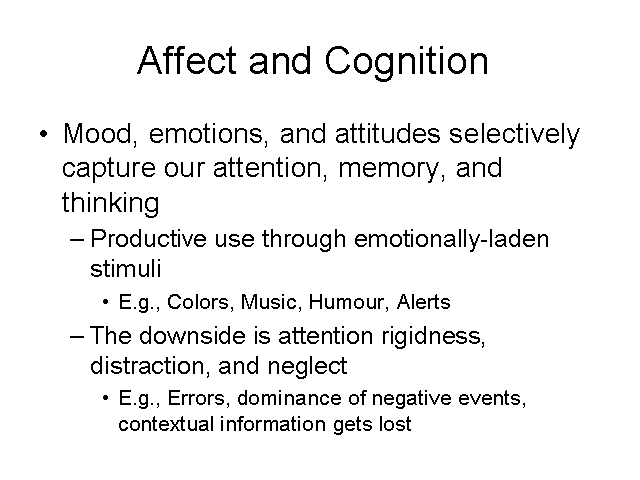
- Mood, emotions, and attitudes selectively capture our attention, memory, and thinking
- Productive use through emotionally-laden stimuli
- E.g., Colors, Music, Humour, Alerts
- The downside is attention rigidness, distraction, and neglect
- E.g., Errors, dominance of negative events, contextual information gets lost
- Productive use through emotionally-laden stimuli

Affect and Cognition
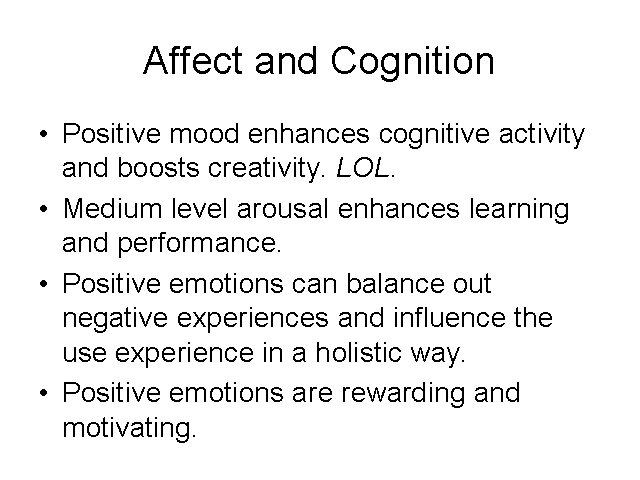
- Positive mood enhances cognitive activity and boosts creativity. LOL.
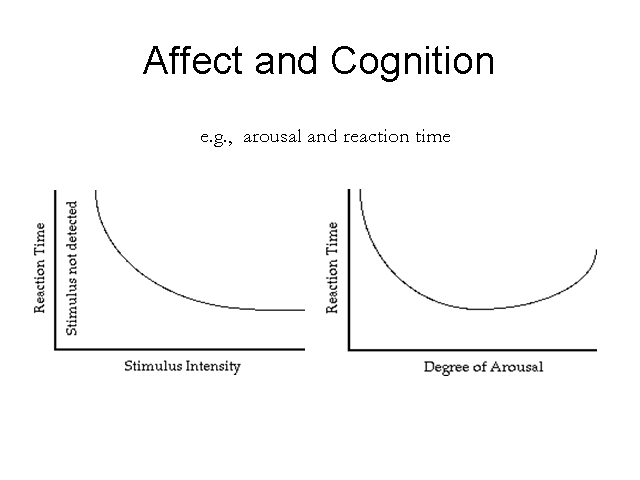
- Medium level arousal enhances learning and performance.
- Positive emotions can balance out negative experiences and influence the use experience in a holistic way.
- Positive emotions are rewarding and motivating.
Affect and Cognition
- Negative emotions and attitudes hinder effective, efficient, satisfying use.
- Anxiety (e.g., fear of failure) reduces Working Memory capacity, causes slower learning, hinders performance (even for easy tasks), and builds up negative attitudes.
- Negative attitudes result in use avoidance, impaired learning and use, and predict negative future attitudes.
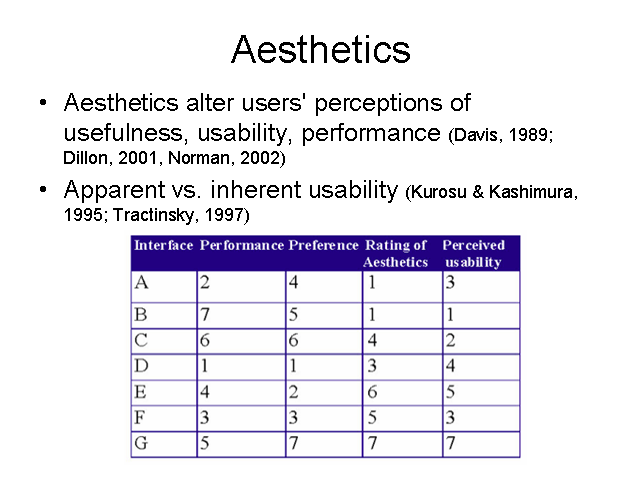
Aesthetics
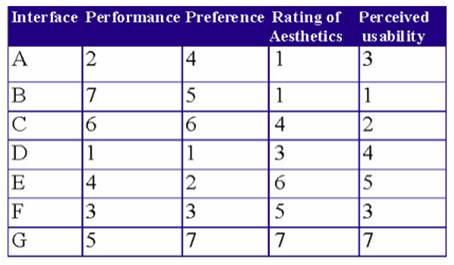
- Aesthetics alter users' perceptions of usefulness, usability, performance (Davis, 1989; Dillon, 2001, Norman, 2002)
- Apparent vs. inherent usability (Kurosu & Kashimura, 1995; Tractinsky, 1997)
Relevance
- People expect things that look good to work better
- Indeed, they often actually do! (e.g., obey laws of perception, motivate people, place them into good mood)
- Self-fulfilling prophecy: Negative expectations affect users’ subsequent evaluation of the interface (i.e., expression of dissatisfaction). (Hiltz & Johnson, 1990)
- However: Don‘t hide bad interaction design behind beauty.
- Also: Aesthetics is not culture-free!
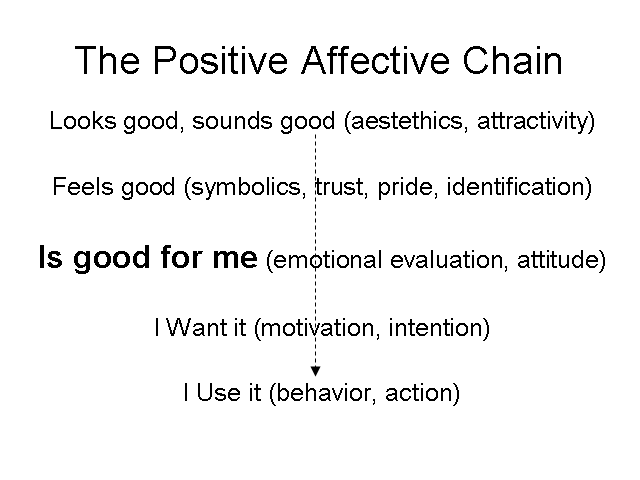
The Positive Affective Chain
- Looks good, sounds good (aestethics, attractivity)
- Feels good (symbolics, trust, pride, identification)
- Is good for me (emotional evaluation, attitude)
- I Want it (motivation, intention)
- I Use it (behavior, action)

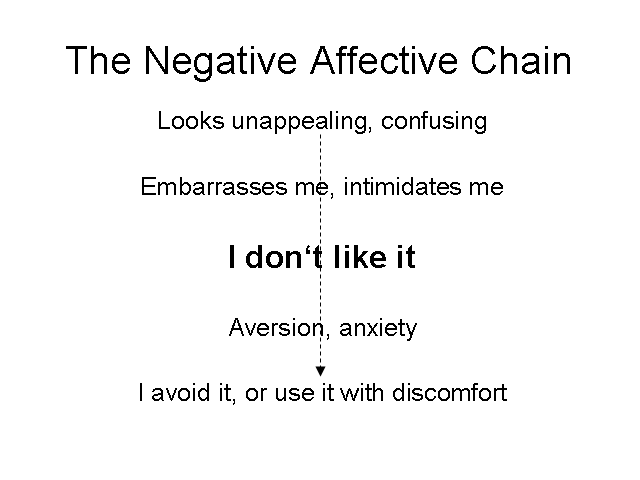
The Negative Affective Chain
- Looks unappealing, confusing
- Embarrasses me, intimidates me
- I don‘t like it
- Aversion, anxiety
- I avoid it, or use it with discomfort

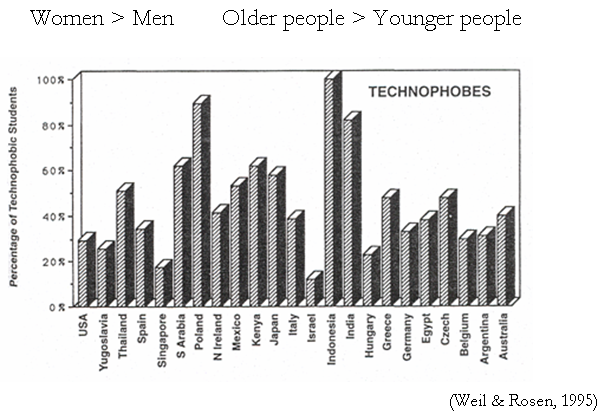
Technophobia & Computer Anxiety
- Think negatively about technology use
- Feel negatively about and during use
- Ineffective and inefficient use
- Use avoidance



„Fear Factors“
- Disposition
- Lack of clarity (what, how, where, who, why)
- Lack of control
- Relevance of outcome
- Lack as well as type of prior experiences (especially failures and errors)
References
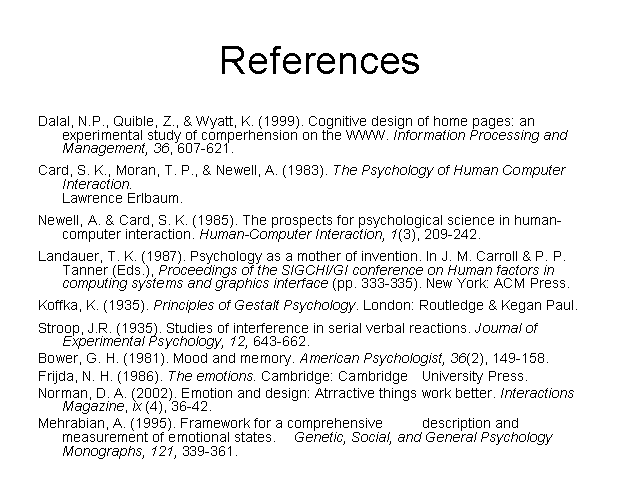
- Dalal, N.P., Quible, Z., & Wyatt, K. (1999). Cognitive design of home pages: an experimental study of comperhension on the WWW. Information Processing and Management, 36, 607-621.
Card, S. K., Moran, T. P., & Newell, A. (1983). The Psychology of Human Computer Interaction.
Lawrence Erlbaum.
- Newell, A. & Card, S. K. (1985). The prospects for psychological science in human-computer interaction. Human-Computer Interaction, 1(3), 209-242.
- Landauer, T. K. (1987). Psychology as a mother of invention. In J. M. Carroll & P. P. Tanner (Eds.), Proceedings of the SIGCHI/GI conference on Human factors in computing systems and graphics interface (pp. 333-335). New York: ACM Press.
- Koffka, K. (1935). Principles of Gestalt Psychology. London: Routledge & Kegan Paul.
- Stroop, J.R. (1935). Studies of interference in serial verbal reactions. Journal of Experimental Psychology, 12, 643-662.
- Bower, G. H. (1981). Mood and memory. American Psychologist, 36(2), 149-158.
- Frijda, N. H. (1986). The emotions. Cambridge: Cambridge University Press.
- Norman, D. A. (2002). Emotion and design: Atrractive things work better. Interactions Magazine, ix (4), 36-42.
- Mehrabian, A. (1995). Framework for a comprehensive description and measurement of emotional states. Genetic, Social, and General Psychology Monographs, 121, 339-361.
References
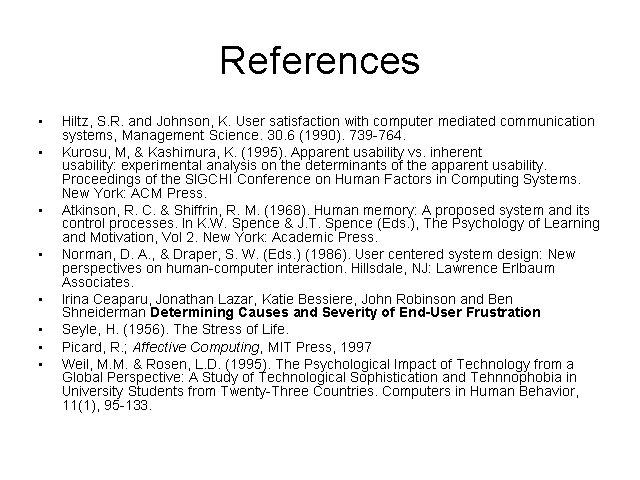
- Hiltz, S.R. and Johnson, K. User satisfaction with computer mediated communication systems, Management Science. 30.6 (1990). 739-764.
- Kurosu, M, & Kashimura, K. (1995). Apparent usability vs. inherent usability: experimental analysis on the determinants of the apparent usability. Proceedings of the SIGCHI Conference on Human Factors in Computing Systems. New York: ACM Press.
- Atkinson, R. C. & Shiffrin, R. M. (1968). Human memory: A proposed system and its control processes. In K.W. Spence & J.T. Spence (Eds.), The Psychology of Learning and Motivation, Vol 2. New York: Academic Press.
- Norman, D. A., & Draper, S. W. (Eds.) (1986). User centered system design: New perspectives on human-computer interaction. Hillsdale, NJ: Lawrence Erlbaum Associates.
- Irina Ceaparu, Jonathan Lazar, Katie Bessiere, John Robinson and Ben Shneiderman Determining Causes and Severity of End-User Frustration
- Seyle, H. (1956). The Stress of Life.
- Picard, R.; Affective Computing, MIT Press, 1997
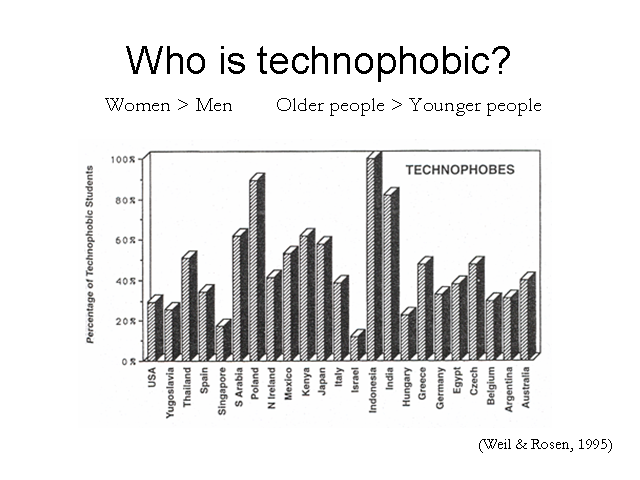
- Weil, M.M. & Rosen, L.D. (1995). The Psychological Impact of Technology from a Global Perspective: A Study of Technological Sophistication and Tehnnophobia in University Students from Twenty-Three Countries. Computers in Human Behavior, 11(1), 95-133.